How many puzzles are in Order of the Sinking Star?
Order of the Sinking Star has roughly 1,500 puzzles, according to launch coverage featuring interviews with creator Jonathan Blow. That makes it a substantial commitment: Blow estimates the game could take around 500 hours to complete. If you have seen a figure of 105 puzzles, that refers to community reports about the earlier Part 2 demo.
The most useful answer for someone considering the full game is therefore about 1,500. Keep the approximation attached, because published coverage uses several different figures and does not provide a consistent, itemized checklist.
| Public coverage | Reported puzzle count | How to interpret it |
|---|---|---|
| GamesBeat interview with Jonathan Blow | As many as 1,500 | An approximate figure describing the full game's scale |
| BBC interview, October 6, 2026 | Roughly 1,500 | A prelaunch estimate accompanying Blow's completion-time estimate |
| Postmode review, October 7, 2026 | Nearly 1,000 | A different figure used in review coverage |
| YouTube review | More than 1,000 | A broad description from a reviewer who had not finished everything |
For planning purposes, the two interviews make approximately 1,500 the strongest supported headline answer. For tracking completion, however, an approximate headline cannot establish exactly how many entries your save should display. The demo's reported totals also need to stay separate from the full release.
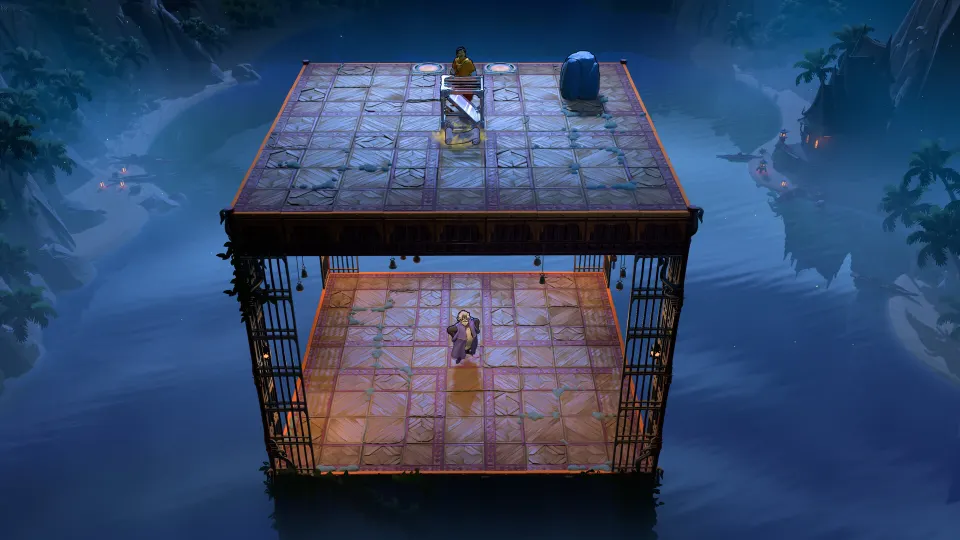
Why do different puzzle totals appear?
The difference between “nearly 1,000” and “roughly 1,500” is real, but a definitive explanation for that difference has not been officially confirmed. Neither figure comes with a complete breakdown showing which individual challenges, overworld interactions, or milestones are included.
The game's structure helps explain why a counting method matters. Some challenges occupy individual puzzle spaces, while exploration connects them through a larger overworld. As you advance, mechanics from separate regions interact, and puzzle elements begin affecting what the Queen can do outside those individual spaces.
Those structural details do not establish how each publication arrived at its number. It would be speculation to declare that one figure excludes secrets, that another counts every overworld obstacle, or that the gap represents a specific batch of additional puzzles.
When comparing numbers, check three things:
- Version: Is the number about the full release or a particular demo phase?
- Measurement: Does it describe puzzles, level files, stars, or a saved completion counter?
- Precision: Is it an approximate description or a documented count for a specific build?
These distinctions are especially useful when an older discussion appears in search results. A detailed demo completion report can be accurate for that demo while answering a different question from the total size of the finished game.
How many puzzles are in the Part 2 demo?
Players in the Part 2 demo discussion repeatedly reported 105 puzzles and three big stars. The same discussion references promotional wording of “around 110” puzzles, which prompted players to search for additional challenges after reaching 105.
| Number | What it describes | Reliability and limitation |
|---|---|---|
| 105 puzzles | The total repeatedly reported by Part 2 demo players | Community agreement for that demo |
| Three big stars | Additional progress reported alongside the 105 puzzles | Listed separately by players |
| Around 110 puzzles | Promotional wording cited in the discussion | An approximate figure |
| 109 levels | One commenter's claimed count of game files | Unverified and said to include non-puzzle levels |
The repeated 105-puzzle reports are useful if you are checking your progress in that particular demo. They provide a practical comparison point, although community agreement alone is not a complete official checklist.
Keep the three big stars separate when comparing your save with those reports. The discussion presents them alongside the puzzle total; it does not establish that you should add them together and expect a displayed count of 108.
If your Part 2 demo total seems low:
- Confirm that you are comparing the same demo phase.
- Check the puzzle total shown for your saved campaign.
- Revisit unexplored map areas and look for stars.
- Compare your big-star progress separately from your puzzle count.
Players describe viewing their saved total through Load different campaign in the menu. One reported route is to quit, return, and select that option. This is a community tip associated with the demo discussion.
A player reporting 103 puzzles was also advised to explore further for the remaining two. That supports checking the map before assuming a counter problem, but it does not identify exact puzzle locations or establish a walkthrough.
How are the full game's puzzles organized?
The puzzles are spread across four main worlds that eventually combine their mechanics. Each begins with ideas adapted, with permission, from another designer's puzzle game. Thekla expands those ideas into connected regions, then introduces situations where abilities and objects from different worlds must work together.
The Postmode review identifies the four underlying games and describes how their systems meet as exploration progresses.
| Main direction | Underlying game | Central puzzle ideas |
|---|---|---|
| North | Heroes of Sokoban by Jonah Ostroff | Characters with different abilities manipulate objects and help one another |
| East | Mirror Isles by Alan Hazelden | Mirrors allow position swaps and movement between otherwise separated spaces |
| West | Promesst by Sean Barrett | Gems, light beams, and environmental interactions shape movement and progression |
| South | Skipping Stones to Lonely Homes by Alan Hazelden | Skipped stones and water crossings create routes through island environments |
This organization matters when judging how much variety the large total represents. Early puzzles teach the behavior of a particular character or object. Later challenges ask you to apply that understanding in more complicated arrangements, including combinations with mechanics learned elsewhere.
For example, mirrors initially belong to their own region, but later appear alongside characters with distinct object-moving abilities. Knowing each rule individually becomes the starting point for understanding how those rules interact.
The overworld also develops alongside your progress. Individual puzzle solutions can affect exploration, giving the Queen new ways to navigate the larger environment. Consequently, the experience extends beyond selecting isolated rooms from a level list.
An exact puzzle count for each world has not been officially confirmed. Dividing 1,500 by four would therefore produce a misleading regional target: the game's combined areas and overworld interactions complicate any simple equal split.
How long does solving the puzzles take?
Around 500 hours is Jonathan Blow's estimate for completing the game. Both the BBC interview and The New York Times profile report that figure. It is a creator's estimate, so it should not be treated as a measured average across players or a guaranteed finishing time.
Your pace will depend on how quickly particular mechanics make sense, how thoroughly you explore, and how often a difficult arrangement holds you up. Early teaching puzzles and later combinations can demand very different amounts of time, making a fixed puzzles-per-hour target unreliable.
The game gives you several ways to manage a long session:
- Change regions: Explore another available route when one puzzle stops making sense.
- Undo moves: Reconsider a recent decision without repeating the entire attempt.
- Reset a puzzle: Start over when the current arrangement becomes difficult to untangle.
- Return later: Use time away to reconsider an assumption that may be blocking progress.
Reviews describe a nonlinear structure that allows progress elsewhere when a particular challenge becomes frustrating. You do not need to finish every puzzle in one direction before exploring another available area.
For planning, set aside time to understand a mechanic or investigate a route. The total communicates the game's scale, but it is a poor measure of what a productive individual session should look like.
FAQ
What is the quick answer to “order of the sinking star how many puzzles”?
The full game has roughly 1,500 puzzles, according to GamesBeat and BBC interviews with Jonathan Blow. That is the best-supported approximate answer. The frequently discussed 105 puzzles plus three big stars belongs to community reports about the Part 2 demo.
Does the game have exactly 1,500 puzzles?
The interview coverage uses approximate wording. An exact, itemized total reconciling the different published counts has not been officially confirmed. Use about 1,500 to understand the full game's scale, while keeping any version-specific completion counter separate.
Why do some reviews mention about 1,000 puzzles?
Postmode describes nearly 1,000, while another review describes more than 1,000. Those accounts use different figures from the roughly 1,500 reported in interviews. A confirmed explanation for the discrepancy is unavailable, so attributing it to secrets, cut content, or a specific counting rule would be speculation.
Have I missed five puzzles if my Part 2 demo shows 105?
Multiple players reported stopping at 105 puzzles and three big stars. The promotional figure discussed was “around 110,” so reaching 105 does not by itself establish that five puzzles remain undiscovered. Compare both your puzzle count and big-star progress with reports for the same demo phase.
Must I solve every puzzle in one world before moving on?
No. Reviews describe being able to leave a difficult challenge and pursue another available region. Exploring different directions also prepares you for later puzzles that combine their mechanics, so changing regions is a useful way to continue learning while a particular solution remains elusive.