Does Order of the Sinking Star have multiplayer?
Order of the Sinking Star is a single-player puzzle adventure, so you should not buy it expecting an official co-op session with a friend. Its multiple playable heroes belong to one player's adventure. If your group wants separate characters controlled by separate people, that distinction matters before anyone purchases a copy.
The official Steam page lists single-player among the game's features. It does not advertise online multiplayer, local co-op, or a competitive mode.
| Mode or feature | Advertised status | What it means for players |
|---|---|---|
| Single-player | Listed on Steam | One player explores and solves puzzles. |
| Online co-op | Not listed as supported | Do not expect a friend to join your session. |
| Local co-op | Not listed as supported | Multiple heroes do not establish separate player slots. |
| Split-screen | Not advertised | There is no advertised split-screen mode to select. |
| Competitive multiplayer | Not advertised | No versus mode is advertised. |
| Cross-platform multiplayer | Not officially confirmed | Availability on several platforms does not establish crossplay. |
This is a substantial solo adventure built around more than 1,000 handcrafted puzzles and four worlds whose mechanics eventually interact. The challenge comes from understanding those rules and coordinating abilities, rather than coordinating a party of human players.
Friends can still discuss solutions while one person plays. That can make the experience social, especially when a second perspective reveals an overlooked move. It remains informal collaboration within a single-player game, however, and should not be confused with a supported multiplayer feature.
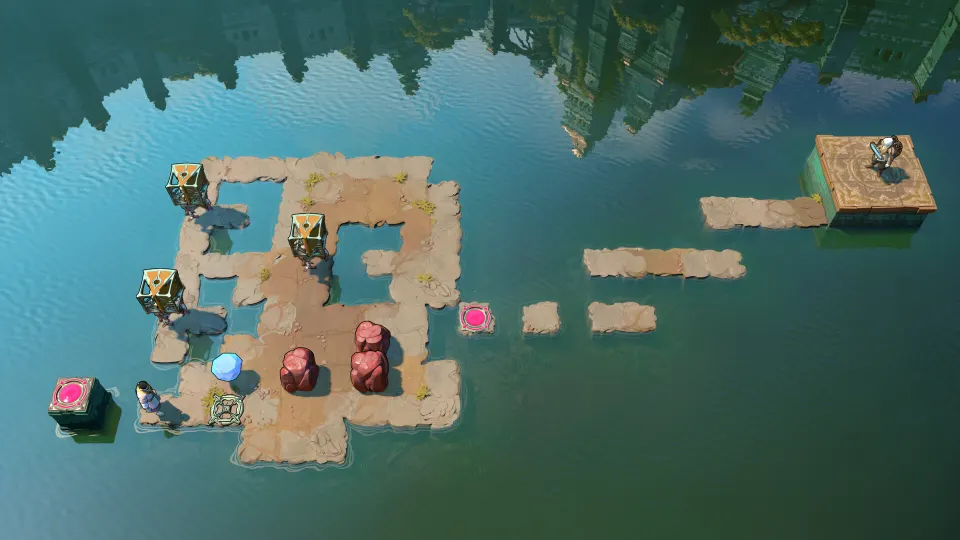
Why multiple heroes do not mean multiple players
The playable cast is a likely reason players ask about co-op. Order of the Sinking Star includes characters with complementary abilities, and some puzzles bring several of them together. A scene containing a warrior, thief, and wizard can resemble a cooperative party game at first glance.
Their abilities instead create different ways for one player to manipulate a puzzle. Moving the right character at the right moment can change which routes, objects, or positions become available.
| Hero | Puzzle ability | What the player must consider |
|---|---|---|
| Warrior | Pushes groups of objects | Whether moving several objects opens a route or blocks another. |
| Thief | Pulls objects while moving | How dragging something changes the arrangement behind her. |
| Wizard | Swaps positions with objects or characters | Whether exchanging positions creates a useful new configuration. |
These interactions explain why several characters can be necessary without requiring several people. You are working out a sequence across their different abilities. A character who seems unhelpful in one position may become essential after another hero rearranges the area.
The broader adventure applies the same idea to its worlds. Mirror mechanics, stones used to cross water, and beams that alter abilities introduce different puzzle rules. As those systems meet, familiar actions acquire new consequences. The official game website describes this merging of worlds and mechanics as a central part of the design.
None of that establishes simultaneous control by additional players. Community comments discuss controlling one character at a time, but they should not be treated as a formal explanation of the developer's reasons for choosing single-player. The supported mode is clear; a detailed official rationale for excluding co-op has not been established.
How to enjoy the puzzles with a friend
Although there is no advertised co-op mode, shared problem solving can still work well. One person handles the controls while both examine the board, suggest moves, and test ideas. Sitting together is the most straightforward arrangement because everyone can see the same puzzle state.
The game's existing puzzle tools can help this kind of informal collaboration. They support experimentation and breaks without creating an additional player slot.
| Single-player feature | What it does | How it helps shared solving |
|---|---|---|
| Rewind | Lets the player undo mistakes | You can test a suggestion and reconsider the result. |
| Flexible exploration | Allows players to leave challenges and revisit worlds | You can switch puzzles when discussion stops producing new ideas. |
| Preserved puzzle progress | Lets players resume puzzles where they left off | You can return later without reconstructing the entire attempt. |
Agree on how much help each person wants before tackling a difficult area. Someone enjoying a fresh discovery may prefer a small nudge, while another player may welcome a full discussion of possible solutions. Having that agreement makes the session more enjoyable for both.
A few practical habits help keep everyone involved:
- Choose who operates the controls. Keep one person responsible for entering moves during an attempt so the intended sequence stays clear.
- Ask before revealing an answer. Start with an observation or question, especially if you have already completed the puzzle.
- Explain the purpose of a move. Describe what it might open or change, giving the other person room to evaluate the idea.
- Use rewind to investigate. An unsuccessful experiment can still reveal a rule or eliminate an assumption.
- Switch puzzles when you stall. Another world may offer a different kind of problem and a useful mental break.
- Take turns manually if desired. Passing the controller changes who operates the solo game; it does not activate co-op.
These habits also fit the game's community culture. The launch announcement on Reddit encourages hints before complete solutions and asks players to hide explicit answers behind spoiler tags. The same courtesy helps when your puzzle partner is sitting beside you.
What Steam features and co-op requests mean
Several Steam features can sound social without indicating multiplayer. The store lists achievements, Steam Cloud, and Family Sharing alongside single-player. Each label describes a different function, so it helps to separate account and save features from the ability to join another person's game.
| Steam feature | What it concerns | Does it establish multiplayer? |
|---|---|---|
| Single-player | The advertised player mode | It identifies the adventure as a solo experience. |
| Steam Achievements | Recognition of gameplay accomplishments | No; achievements do not create shared sessions. |
| Steam Cloud | Cloud storage of supported game data | No; cloud saving is not cooperative play. |
| Family Sharing | Access through Steam's sharing system | No; library access does not add co-op controls. |
Family Sharing is particularly easy to misread. Its presence does not mean two family members can control different heroes in the same puzzle. Likewise, Steam Cloud should not be interpreted as a system for synchronizing a live adventure between friends.
There is community interest in cooperative play. A Steam discussion about co-op includes requests for a cooperative expansion and suggestions involving Workshop levels. Those posts express player preferences. They do not constitute a developer announcement, a release schedule, or proof that such features are being built.
The discussion also contains differing opinions about how cooperative puzzle design might work. Some participants welcome shared solving, while others prefer a complete solo experience. Neither position establishes the studio's plans. A co-op update, multiplayer expansion, or Workshop-based cooperative mode has not been officially confirmed.
The official website lists Steam, PlayStation 5, and Nintendo Switch 2 as available platforms. That establishes where the game can be played. It does not establish cross-platform sessions or a multiplayer mode exclusive to a particular console.
FAQ
Can two people play on the same couch?
Two people can sit together and discuss the puzzles while one operates the game. Local co-op and split-screen are not advertised features. If your requirement is two controllers providing independent control at the same time, the game's single-player listing does not meet that requirement.
Can my friend control the wizard while I control the warrior?
There is no advertised mode that assigns those heroes to separate players. Their complementary abilities are part of the solo puzzle system. You can agree on moves together or pass control between attempts, but that arrangement does not provide independent character ownership.
Does the game support crossplay between PC and consoles?
Cross-platform multiplayer has not been officially confirmed. The game is available on Steam, PlayStation 5, and Nintendo Switch 2, but platform availability alone says nothing about shared sessions. Do not purchase copies on different systems expecting to connect through a cooperative lobby.
Do I need another person to complete the puzzles?
No partner is required by the advertised single-player design. Puzzles involving several heroes ask you to coordinate their abilities yourself. A friend may help you notice an interaction, but multiple characters are not evidence of a challenge that requires additional human players.
Is a co-op DLC or multiplayer update planned?
No co-op release date or multiplayer expansion has been officially confirmed. Community suggestions about DLC and Workshop support are requests, not commitments. If multiplayer is your deciding factor, base your purchase on the advertised single-player experience rather than an assumed future addition.
Where should I check for multiplayer changes?
For changes to order of the sinking star multiplayer support, check the official Steam feature list and announcements from Thekla or the game's publishers. Look for an explicit description of supported modes and player counts. Forum speculation alone does not establish that a new mode exists.